- asiabits
- Posts
- 🟠 World first: China approves brain implant
🟠 World first: China approves brain implant
+ Moonshot AI Hits $18B

☕️ Good morning friends,
Nothing but bad news everywhere, war and crises.
But not with Asiabits. Today's Top Bit is super exciting and makes the world a better place.
In today's issue:
China approves first commercial brain implant
LG chief on robotics tour in Shanghai
Japan invests $380 billion in research and technology
Enjoy reading! 📰
P.S. Which Asian market is right for your business? Check it out with our interactive tool.

Won hits 17-year low: The South Korean won slipped past 1,500 per dollar on Monday for the first time since 2009 as the Iran crisis enters its third week and Brent crude surged to $106 a barrel.
The KOSPI still closed +1.1% higher at 5,550 points as large-cap tech stocks bounced back after Friday's sell-off.
TOP BIT
World premiere: China approves first commercial brain implant
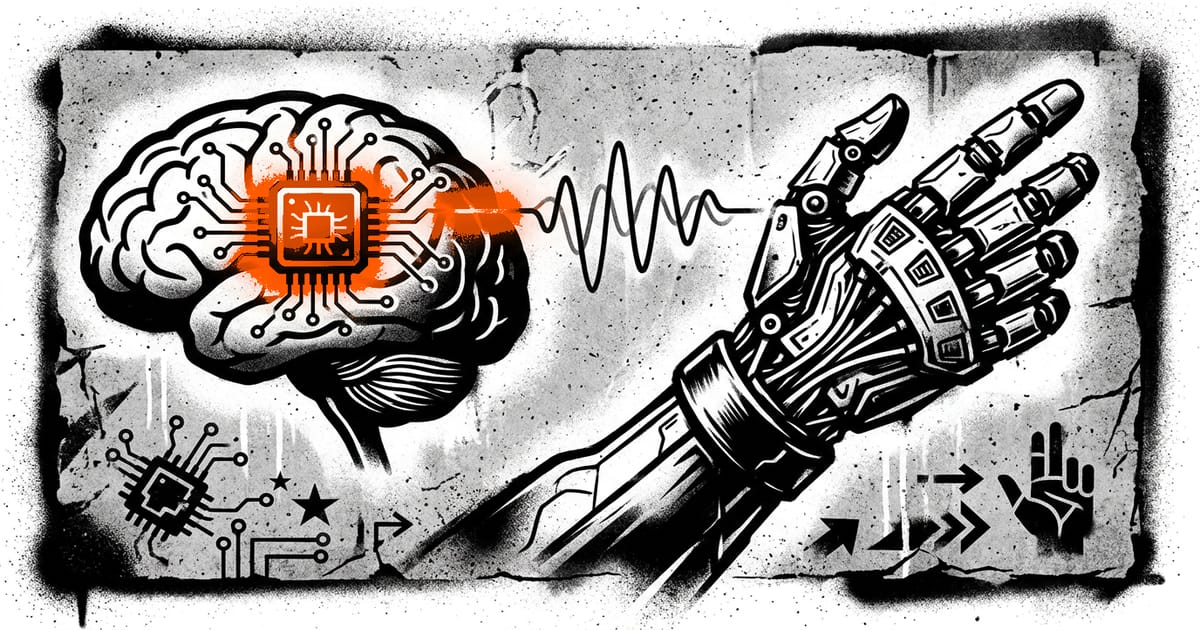
While Elon Musk's Neuralink is still stuck in the clinical testing phase, China has created facts:
The national regulatory authority (NMPA) has approved the world's first invasive brain-computer interface (BCI) system for commercial sale.
The product from Shanghai startup Neuracle Technology marks the starting signal for a new global billion-dollar market.
The "thought glove" for paralyzed patients
The approved system is specifically designed for patients with spinal cord injuries who can no longer move their hands.
Technology: A coin-sized, wireless implant is placed on the brain surface (without penetrating the tissue). It reads neural signals and translates them into commands.
Hardware: The signals control a robotic glove that works with air pressure and enables patients to grasp objects solely through the power of their thoughts.
Limitation: The current approval only applies to patients who still have residual function in their upper arm.
Alibaba & Tencent jump in
Parallel to the approval, there was another financial earthquake on Friday: BCI startup StairMed raised over 500 million yuan (approx. $72.6 million) in a funding round led by Alibaba.
First double pact: StairMed is the first company in the industry to be financed by both Alibaba and Tencent.
Scaling: The goal is 40 implantations by the end of 2026 – which would allow StairMed to overtake Neuralink's case numbers (currently 21).
Stock rally: Following the news, shares of BCI-related companies in Hong Kong and Shenzhen (e.g., Sanbo Hospital, Inkon Life) rose by over 10%.
Beijing has defined BCI as one of six strategic future industries.
Target: "Two to three" global players by 2030. The government has pledged to accelerate approvals and create reimbursement guidelines – before products even hit the market.
All details & data: Scientific American, SCMP, Bloomberg
OUR PARTNER

Our partner CEIBS shows on March 25 how to take your career to the next level.
And the best part? We'll be there too. Register here.
MARKET BIT
Moonshot AI Hits $18B: Kimi Boom Quadruples Valuation
Chinese AI company Moonshot AI is in talks for a new funding round of up to $1 billion that would value the startup at around $18 billion. As recently as late 2025, its valuation stood at $4.3 billion.
Valuation jump: $4.3 billion → $10 billion → $18 billion in less than three months.
The details
Moonshot was founded by Yang Zhilin, who previously worked on AI projects at Meta and Google.
Its core product: Chatbot Kimi, one of the most widely used AI assistants in China, with paid subscription tiers for consumers and technology licensing for enterprises.
The trigger behind the valuation surge: Kimi Claw. The new AI agent is based on the company’s in-house K2.5 model and has completely changed the business. After launch, Moonshot’s monthly revenue exceeded the company’s entire revenue for the previous year.
Investors: Alibaba, Tencent, and 5Y Capital increased their stakes in the $10 billion round. Who will join the $18 billion round has not yet been disclosed publicly.
Kimi Claw: the 24/7 money-printing machine
Kimi Claw is Moonshot’s cloud version of the open-source framework OpenClaw. Instead of just generating text, the AI agent autonomously carries out tasks.
How it works: It runs entirely in the browser, with no setup required. The agent works 24/7 in the cloud, even when the computer is turned off.
Foundation: Kimi’s K2.5 model, a 1-trillion-parameter mixture-of-experts model that Moonshot released in January.
Use cases: Automated market reports, data analysis, writing and debugging code, sorting emails. There are more than 5,000 community-built skills on the company’s own “ClawHub.”
The China comparison
Moonshot is one of China’s “AI Six Tigers,” the startups competing with OpenAI and Anthropic. Rivals Zhipu and MiniMax are valued at $30–40 billion, and Moonshot is now catching up at $18 billion.
Rival comparison: Zhipu and MiniMax are already listed in Hong Kong, but both are still burning significantly more cash than they generate in revenue.
Zhipu posted a 2024 loss of RMB 2.47 billion on revenue of just RMB 312 million.
Moonshot is taking a different path: instead of pursuing an IPO, the startup is sitting on more than RMB 10 billion ($1.4 billion) in reserves, and Kimi Claw is delivering real revenue for the first time.
Sources: Bloomberg, SCMP, Tech Funding News
NUMBER OF THE WEEK

This is how much Japan plans to invest in research and technology over the next five years, twice as much as before.
Focus areas: AI, space, nuclear fusion
Problem: Only 7.7% of Japan’s R&D spending comes from the government (OECD average: 11.3%)
Total target, together with the private sector: $1.13 trillion
The government is doubling its share to draw companies into fields such as nuclear fusion, where investments still do not yet pay off. In addition, there will be higher tax incentives for companies that collaborate with universities.
Prime Minister Takaichi has declared 61 key technologies across 17 fields a national priority. With this, Japan is sending its clearest signal in decades that it does not want to sit on the sidelines in the global tech race.
HIGHLIGHTS
🇰🇷 LG CEO on robotics tour in Shanghai: LG CEO Lyu Jae-cheol visited AgiBot in Shanghai this week, one of the world's largest humanoid robot makers. Focus areas: mass production, data training farms and actuator supply chains. LG invested in AgiBot last August and plans to begin field trials of its household robot CLOiD from 2027. Lyu also attended AWE 2026, China's largest consumer electronics expo.
🇨🇳 Huawei veterans build AI power supply: Shanghai-based Matrix Power Technologies closed a Series A in the eight-figure RMB range, sole investor: StarCharge. The ex-Huawei founders develop high-voltage DC systems (400V/800V) for GPU clusters, whose per-rack consumption is now heading toward megawatt levels. The global data center power equipment market is projected to reach 101 billion USD by 2028. Delta Electronics currently dominates with ~80% market share.
🇰🇷 SK On pivots to energy storage: SK On's ESS division is in talks with US data center and energy developers, targeting at least 10 GWh in contracts this year. The company is building LFP cells, a technology Korean battery makers long dismissed as inferior. EV production lines in Georgia and Tennessee are being converted to ESS lines. BloombergNEF projects US data center power demand will reach 78 GWh by 2035.
🇨🇳 China Tech weathers the storm: While the Stoxx Asia Tech 100 dropped 10% recently and the Nasdaq 100 fell 2.3%, the MSCI China Tech 100 only slipped 1%. JPMorgan portfolio manager Oliver Cox cites cheap valuations and consistent AI strategy as the reasons. Chinese tech companies are more consumer-facing than their US peers, which primarily serve enterprise clients. His Pacific Technology fund has 31% China allocation and is up 10.7% in 2026.
MORE ASIABITS
Free guide: AI Automation for Beginners
Humanoid Robotics Report: The $6 Billion Bet
Interactive tool: China Dependency Index™
YOUR FEEDBACK
How do you like today's briefing? |