- asiabits
- Posts
- 🟠 Where are China's babies?
🟠 Where are China's babies?
Reading time: 4 min 33 sec
In partnership with


Today’s edition is written by:
Anna, Michael & Thomas
☕️ Good morning friends,
While the aging population generally burdens the Chinese economy, it can also be turned into a solid business model:
One Chinese student earned $39,000 in two years by teaching 700 seniors how to ride a bicycle.
P.S. We’ve created a guide for your next business trip to China.
You can get it for free if you help us improve 👇🏻
ON A PERSONAL NOTE
Give us 3 minutes of your time, and we’ll give you our 33-page China Insider Guide. Sounds fair?
Join our quick survey. 🤝

Beijing taps the brakes: Record outflows from major China ETFs are seen as a signal that state-backed investors are taking profits to cool the rally.
Seoul ignores the memo: The KOSPI briefly topped 4,900 intraday, marking 12 straight days of gains. Auto and tech stocks powered the latest record run.
TOP BIT
📉 China’s population is shrinking—despite baby bonuses

Limited Edition
China’s birth rate hit a record low in 2025: only 7.9 million babies were born—17% fewer than in 2024 and less than half of the 2016 peak.
Beijing is pumping billions into baby bonuses, but young Chinese are saying: "Too little, too late."
Details
Subsidies falling flat: Beijing’s national support programs, such as the monthly subsidy of up to 10,800 yuan ($1,534) for children under three, are seen as a "drop in the bucket."
High youth unemployment and skyrocketing living costs are massive deterrents for young couples, despite government bonuses.
More rings, fewer pacifiers: In 2025, the number of marriages rose by 8.5% (Shanghai: +38.7%). However, demographers remain pessimistic about the birth rate: "A return to positive growth is almost impossible."
Projections for 2100: People over 60 already make up 20% of the population today. UN forecasts suggest that by 2100, half of all Chinese people could be over the age of 60.
Robots instead of babies: Faced with a shrinking workforce, Beijing is increasingly focusing on the "development of a high-quality population."
👉🏻 In practice, this means massive investment in industrial automation to compensate for labor shortages through robots.
The legacy of the "One-Child Policy": January 1, 2026, marked the 10th anniversary of the abolition of the One-Child Policy. However, the trauma runs deep 👇🏻
When Peng Peiyun (head of the Family Planning Commission from 1988–1998) died in December 2025, there was little sympathy on the Chinese internet.
"Those children are waiting for you in the afterlife," wrote one Weibo user. Forced abortions and sterilizations characterized her era.
Takeaway
China risks "growing old before it gets rich." The demographic shift is likely "irreversible," despite actions such as a new VAT on condoms.
Introducing the first AI-native CRM

Connect your email, and you’ll instantly get a CRM with enriched customer insights and a platform that grows with your business.
With AI at the core, Attio lets you:
Prospect and route leads with research agents
Get real-time insights during customer calls
Build powerful automations for your complex workflows
Join industry leaders like Granola, Taskrabbit, Flatfile and more.
NUMBER OF THE DAY

This is how many South Koreans have formally opted out of life-sustaining treatment so far.
📄 “No, thanks”: Since 2018, a law in South Korea has allowed people to refuse life-sustaining treatment once they are medically classified as being “in the end-of-life process.” In the first year alone, 86,000 cases were registered.
📋 Signed off by a doctor: In around 186,000 cases, physicians have formally documented which treatments should be withheld. Since the law took effect, life-sustaining treatment has been forgone in roughly 478,000 cases.
Watch: More than two-thirds of these decisions come from people aged 65 and over. In Seoul, policymakers are now debating whether such decisions should be allowed earlier—before patients lose the ability to decide for themselves.
MARKET BIT
🛫 From demo to factory: Airbus order sends China’s UBTech +8%
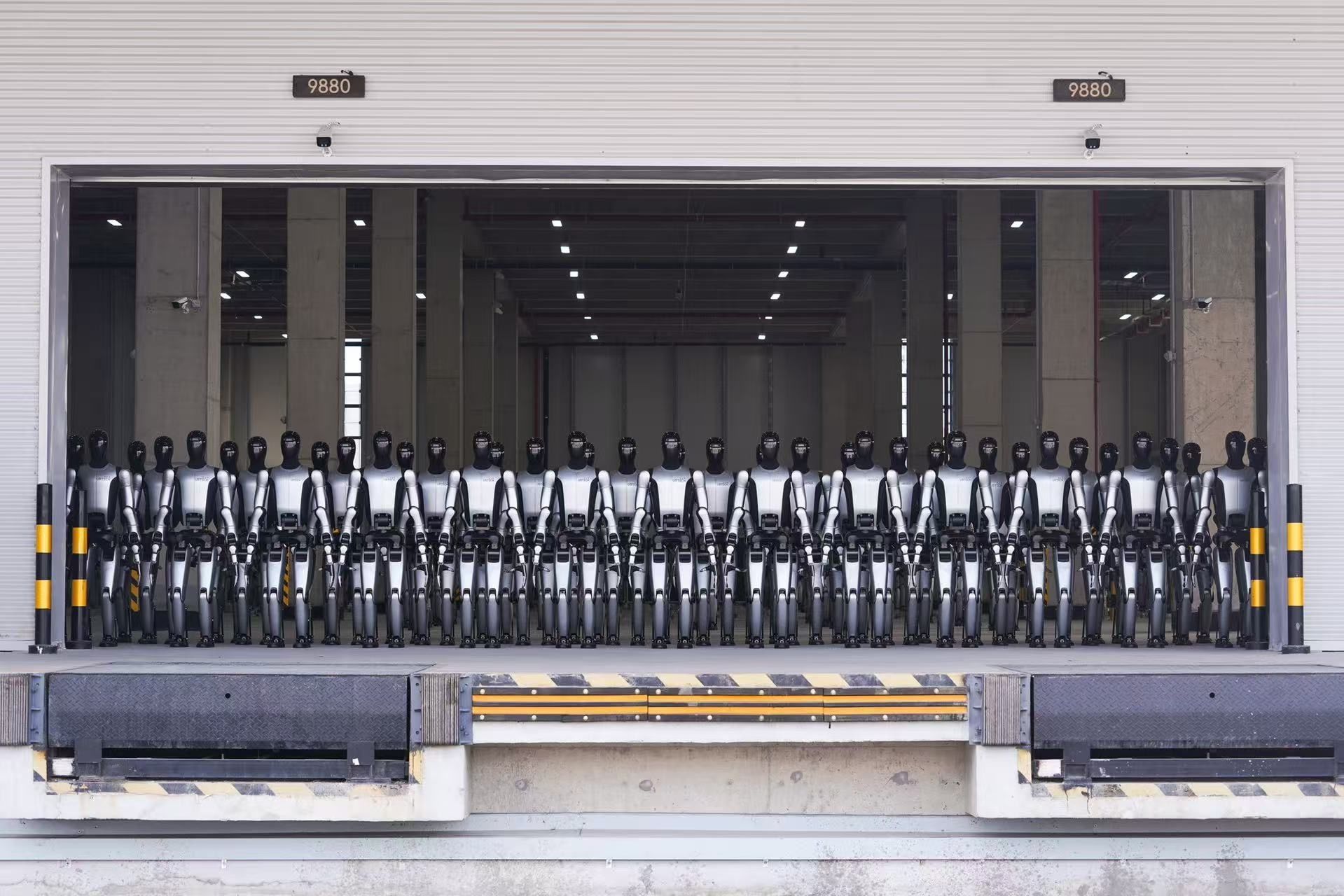
UBTech’s Walker S2 army is ready for work.
Airbus and China’s UBTech signed a service and cooperation agreement over the weekend covering humanoid robots.
🤝 Airbus orders UBTech’s industrial humanoid Walker S2 for use in its aircraft manufacturing plants. Both sides will also jointly test and roll out additional humanoid applications in aviation manufacturing.
Robot momentum: UBTech reports more than USD 200 million in humanoid robot orders for 2025, positioning it as a global leader in the industrial humanoid segment. The company is targeting production capacity of 10,000 units by 2026.
Next level industrialization: Following last year’s partnership with Texas Instruments, UBTech is scaling the Walker S2 with customers such as BYD, Foxconn and SF Express as a true factory tool, expanding deployments across five core industries:
Aviation, automotive, 3C electronics, smart logistics, and semiconductor manufacturing.
Markets cheer: UBTech’s shares jumped about +8.6% after the Airbus deal, closing at HKD 144.7, the highest level since late October.
🦾 Sector context
More and more industrial giants are moving Chinese humanoid robots out of the showroom and onto the factory floor. The international research firm Omdia estimates that ~13,000 humanoids have been delivered globally so far, with the majority being deployed in China.
Investors are betting on this trend: the Solactive China Humanoid Robotics Index has doubled over the past two years. The index tracks the share price performance of Chinese companies active in humanoid robotics.
👉🏻 Full Story: Bloomberg, SCMP, Yicai Global, AAstocks
HEAD OF THE DAY
🇨🇳 Kelly Zong 宗馥莉

🥤The woman steering Wahaha
Kelly Zong is the Vice Chair and CEO of Wahaha, China’s largest beverage company, serving hundreds of millions of consumers nationwide.
A generational business handover
As the daughter of founder Zong Qinghou, one of China’s most legendary entrepreneurs, her rise was never going to be simple. For years, she worked inside the group under her father’s towering presence.
Since assuming full control, Zong has pushed Wahaha into its next phase: refreshing legacy brands, tightening execution, and modernising products across bottled water, dairy, and functional drinks.
Known for her tough management style and obsession with efficiency, she has made it clear that Wahaha’s future won’t rely on nostalgia or family name alone.
HIGHLIGHTS
🚗 Chinese EVs hit the Autobahn: Germany’s €3 billion program to boost electric-car sales will be available to all manufacturers, including Chinese brands like BYD. The incentive, offering €1,500–€6,000 per vehicle, targets low- to middle-income buyers and is expected to support around 800,000 EVs by 2029. Officials stressed there will be no origin-based restrictions, aiming to revive the market while keeping competition open and benefiting both local and foreign automakers.
🎮 Game over? Game usage in South Korea has dropped to 50.2%, its lowest in a decade. Many players are swapping controllers for screens! Streaming platforms, short-form videos, and passive entertainment now dominate leisure time, while “idle” and low-commitment games like MapleStory: Idle RPG rise in popularity. Experts say rising in-game costs, complex systems, and the appeal of watching others play are reshaping how Koreans engage with games.
💾 Taiwan Fab joins the Micron squat: U.S. memory chipmaker Micron will acquire Powerchip’s P5 fabrication site in Taiwan for $1.8 billion, aiming to ramp up DRAM production starting in the second half of 2027. The deal adds 300,000 sqft of cleanroom space and includes a partnership on advanced packaging and legacy DRAM processes, strengthening Micron’s global memory supply amid soaring demand.
COUNTRY READS
🇻🇳 Vietnam will switch nationwide to E5 and E10 biofuels from June 1, 2026, advancing its shift toward cleaner energy. More on this.
🇹🇭 Thailand sees its first tourism decline in four years, driven largely by a sharp drop in Chinese visitors amid safety concerns. More on this.
🇮🇳 Everstone exits Burger King India and Indonesia franchisee Restaurant Brands Asia, selling its full 11.26% stake. More on this.

✅ Treat yourself and make Mango Mochi's with only four ingredients.
✅ Watch how chefs in Korea upgrade Instant Ramen.
✅ Learn to sing this Chinese song for the next KTV Party.
✅ Travel back in time and visit the busiest livestock market on the silk road.
✅ Stay up-to-date and follow us on Instagram.
FORTUNE COOKIE

Hope you have as much fun at work as these guys! 🎸
MORE ASIABITS
All the latest AI trends from Asia — every Wednesday, exclusively with us.
The Asiabits Podcast on YouTube.
The Asiabits Podcast on Spotify.
CAREER BITS
🌏 Sony Pictures: Business Analyst, Information Technology, Tokyo
🌏 Dyson: Assistant Communications Manager, Shanghai
🌏 Tencent: People Operation Manager - Employee Lifecycle, Shenzhen
🌏 OPPO: Senior Retail Marketing Manager, Dongguan
🌏 Samsung: Assistant Manager, Business Development, Bangkok
🌏 Grab: Associate, Account Management, Hanoi
🌏 SKF Group: Digital Product Information Manager, Bengaluru
🌏 Foxconn: Senior Data Scientist, Taipei
🌏 Hyundai: CRM Executive, Dublin
🌏 Huawei: Junior Project Manager, Prague
YOUR FEEDBACK
How did you like today's briefing? |