- asiabits
- Posts
- 🟠 Volkswagen beats BYD in China
🟠 Volkswagen beats BYD in China
+ Li Auto slips into the red

☕️ Good morning friends,
If you're reading this, we're sitting in our podcast studio in Shenzhen listening to how a founder here raised $1.5 million with hardware on Kickstarter… More on that soon.
In today's issue:
Volkswagen is #1 again in the world's largest car market
Li Auto slips into the red
Starbucks Korea as global pioneer
Enjoy reading!
Have a great week!
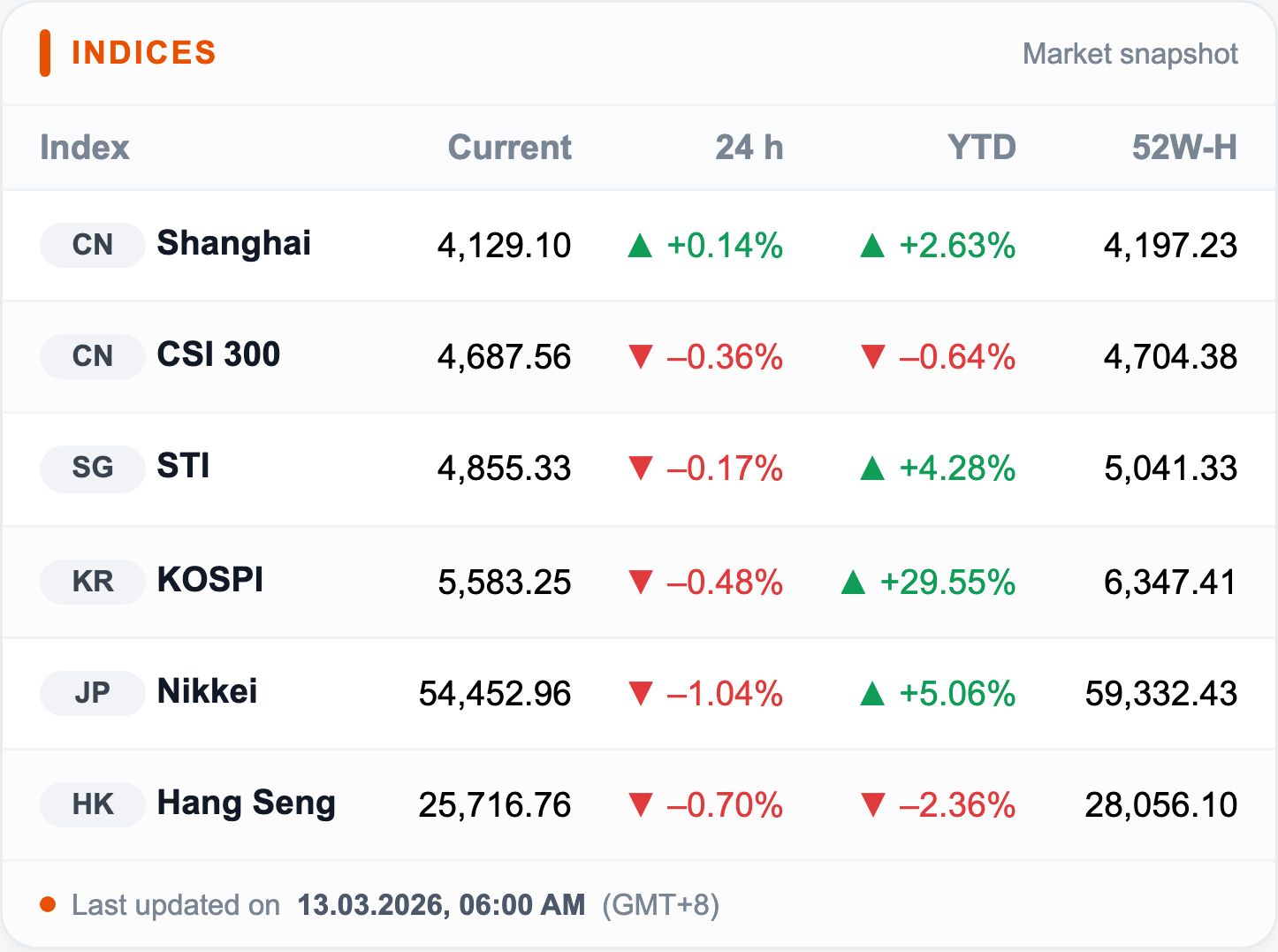
KOSPI drops, smart money buys: South Korea’s benchmark index recently fell 1.7% to 5,487 points, while the blockade of Hormuz pushed oil above $100 per barrel. Wealthy investors see the pullback as a buying opportunity: semiconductor and AI stocks around Samsung and SK hynix are at the very top of their shopping list.
TOP BIT
VW strikes back: throne reclaimed in China after two years

ID.UNYX 08 – made in China for China, Copyright: Volkswagen AG
For a long time, it looked like Volkswagen had permanently lost its footing in its most important market. But the first months of 2026 bring the turnaround: Volkswagen is back at the top of China's car market.
Details
In January and February, VW's joint ventures reached 13.9% market share – just ahead of Geely (13.8%) and well ahead of BYD, which crashed to 7.1%. 4th place instead of 1st.
The reason: Beijing ended purchase tax exemptions for e-cars and cut subsidies for trade-ins.
Rank | Manufacturer / JVs | Market share (Jan-Feb) | Status |
|---|---|---|---|
1. | Volkswagen (FAW/SAIC) | 13.9% | Back at the top; focus on localization. |
2. | Geely | 13.8% | Close behind; strong performance from Volvo/Polestar. |
3. | Toyota (GAC/FAW) | 7.8% | Comeback through strong hybrid demand. |
4. | BYD | 7.1% | Biggest sales slump since the pandemic. |
VW's counterpunch
The German group is betting on radical localization: First co-development with Xpeng rolling off the production line, 20+ new EV models coming in 2026 for China alone.
BYD counters with first major battery upgrade in six years – but the numbers show: Without state help, it's tight.
Despite reclaiming the top spot, the situation remains tense for Volkswagen. After-tax group profit collapsed by 44% to €6.9 billion last year – the weakest result since Dieselgate.
VW plans to cut around 50,000 jobs nationwide by 2030 to reduce transformation costs.
📊 All details & data: Reuters, Volkswagen press release
OUR PARTNER
88% resolved. 22% loyal. Your stack has a problem.

Those numbers aren't a CX issue — they're a design issue. Gladly's 2026 Customer Expectations Report breaks down exactly where AI-powered service loses customers, and what the architecture of loyalty-driven CX actually looks like.
MARKET BIT
Li Auto slips into the red: from profit machine to a 520M yuan operating loss

Li Auto, once China's poster child for profitable EV making, posted an operating loss of 520 million yuan ($75 million) in 2025. Just a year earlier, the company had booked 7 billion yuan in operating profit.
Revenue: -22.3% to 112.3 billion yuan ($16.3 billion).
Deliveries: -18.8% year-on-year.
The details
The slide happened fast. In 2023 and 2024, Li Auto was one of the few profitable EV makers in China, with operating profits of 7.4 and 7 billion yuan respectively.
The MEGA disaster: In March 2024, Li Auto launched its first all-electric model. The minivan flopped. In July 2025, a crash-test video of the i8 turned into a PR nightmare. The pure-electric push ate into margins and credibility.
Q4 shows early stabilization:
Net income: 20.2 million yuan (after Q3 losses).
Vehicle margin: 16.8% (Q3: 15.5%, but Q4 2024: 20.3%).
Free cash flow: back to positive at 2.5 billion yuan.
The full-year picture tells a different story: Operating cash flow swung from +15.9 billion yuan (2024) to -8.6 billion yuan. Free cash flow dropped from +8.2 to -12.8 billion yuan.
The cushion holds: Li Auto is sitting on 101.2 billion yuan ($14.7 billion) in cash. Enough to fund a turnaround without going back to capital markets.
The AI pivot
In November 2025, CEO Li Xiang officially declared the company an “Embodied Intelligence” firm. Half of its 11.3 billion yuan R&D budget is now being allocated to AI.
In January 2026, the engineering teams were reorganized, including the creation of a new humanoid robotics division. For 2026, Li Auto is planning 12 billion yuan in R&D spending, with around half going to AI, chips, and autonomous driving.
Li Xiang himself has called 2026 “the most competitive year” in China’s premium segment. Even so, he is still targeting 20% sales growth in the core auto business.
HIGHLIGHTS
🇯🇵 Japan's first Physical AI Fellow: Telexistence, a Tokyo-based robotics startup, has been selected as the first Asian company for the Physical AI Fellowship run by AWS, Nvidia and MassRobotics. The program supports 9 startups globally with 200,000 USD in AWS credits each and access to Nvidia's Isaac frameworks. Telexistence already operates autonomous robots across Japanese convenience stores.
🇰🇷 Chinese brands go mainstream in Korea: What Korean consumers long dismissed as cheap and inferior is increasingly seen as a smart alternative. Xiaomi, BYD, Miniso and Shein are gaining market share, especially among younger Koreans who prioritize value over brand loyalty. The strategy has shifted: away from pure price leadership, toward user experience, localization and brand-building.
🇮🇩 Kredivo acquires Vietnam's first digital bank: Indonesian fintech unicorn Kredivo has fully acquired Vietnamese digital bank Timo and plans to invest around 15 million USD in Vietnam over the next three years. Timo was founded in 2015 and offers payments, cards and loans. It marks Kredivo's second acquisition in quick succession after buying Indonesian earned wage access startup GajiGesa in February.
🇰🇷 Starbucks Korea sets global precedent: As the first Starbucks market worldwide, the Korean subsidiary now funds master's and doctoral programs for employees. The scholarship covers 37 undergraduate and 9 graduate programs, all fully online. Participants are not required to stay at Starbucks after graduating.
MORE ASIABITS
Free guide: AI Automation for Beginners
Humanoid Robotics Report: The $6 Billion Bet
Interactive tool: China Dependency Index™
YOUR FEEDBACK
How do you like today's briefing? |