- asiabits
- Posts
- 🟠 USA vs China: AI war erupts
🟠 USA vs China: AI war erupts
Anthropic: "China is stealing our AI"

☕️ Good morning friends,
A Chinese proverb says: "The thief shouts loudest: 'Catch the thief!'"
We think that fits perfectly with today's Top Bit.
Also today:
Private equity hunts North Asia's beauty industry
China installs record number of robots
SK Hynix wants to build even more monster chips
Enjoy reading! 📰
P.S. Our first robotics tour takes place in May. → Apply now.

KOSPI nears 6,000: South Korea’s benchmark index hit a new record high of 5,969 points on Tuesday – up 42% since the start of the year. Nomura is the first bank to call a target of 8,000 points. While institutional investors were net buyers of 2.37 trillion won, retail investors took profits aggressively.
The paradox: Despite the rally, short-selling positions stand at a record 149 trillion won.

TOP BIT
AI war: Anthropic accuses China's "tigers" of theft

The US company Anthropic accuses three Chinese AI firms of massively stealing data from its Claude model.
The irony: The company itself paid $1.5 billion in September 2024 for copyright violations.
The accusation
According to Anthropic, DeepSeek, Moonshot AI, and MiniMax created over 24,000 fake accounts and interacted with Claude 16 million times – to train their own models.
The technique: "Distillation" – a large "teacher" model trains a smaller "student" model. Legal when done with your own system. Illegal when tapping into foreign systems.
China's "AI tigers" in the crosshairs
The accused companies belong to China's absolute elite and challenge US market leaders like OpenAI and Anthropic:
Startup | Best-known model | Status |
|---|---|---|
DeepSeek | DeepSeek-V3 | Shocked the industry with high efficiency at low computing power. |
MiniMax | abab | Specialized in AI characters and social interaction. |
Moonshot AI | Kimi | Known for processing extremely long contexts. |
"How the turn tables"
The reactions on the internet were consistently critical.
Why? Because of Anthropic's own history:
September 2024: $1.5 billion settlement – largest copyright settlement in US history
Accusation: 500,000 books illegally downloaded and scanned from shadow libraries
Payment: ~$3,000 per book to authors
OpenAI also made similar accusations against DeepSeek – and is meanwhile itself embroiled in 16 consolidated copyright lawsuits.
📊 All details & data: CNN, The Register, Anthropic Press Release
OUR PARTNER
Want to get the most out of ChatGPT?

ChatGPT is a superpower if you know how to use it correctly.
Discover how HubSpot's guide to AI can elevate both your productivity and creativity to get more things done.
Learn to automate tasks, enhance decision-making, and foster innovation with the power of AI.
MARKET BIT
Private Equity hunts North Asia’s beauty cashflows

Private equity is sweeping through North Asia’s beauty sector — from Japan’s legacy brands to K-Beauty and Chinese high-end studios. Financial investors are systematically buying into high-margin consumer brands.
The logic: established brands + operational efficiency + international rollout = predictable value creation.
Japan: Governance Meets Capital
In Japan, corporate governance reforms have paved the way for take-privates and carve-outs. CVC and KKR are currently locked in a bidding war for Mandom. At the same time, Bain is acquiring FineToday for around 200 billion yen (~$1.3 billion).
FineToday was estimated by the market at roughly ~15x EBITDA.
Japan offers less of a demographic growth story — but strong structural valuation levers.
South Korea: K-Beauty Becomes a Financial Asset
In 2025, nearly every major beauty transaction in Korea was PE-driven. Blackstone acquired Juno Hair, CLSA invested in Jung Saem Mool, and KKR bought packaging manufacturer Samhwa for $528 million.
Notably, many deals involve OEM/ODM players, packaging, and devices. Whoever controls production controls global scaling. Financial investors are using this to internationalize Korean brands.
Next phase: Beauty + Tech. Virtual makeup tools, at-home devices, digital skin analysis. Expected market growth through 2030: ~4.8% CAGR.
China: Premium & Platform
China represents premiumization: particularly in high-end beauty and spa services. International investors are positioning early in brands with pricing power and export potential.
Why Capital Is Flowing Now
Predictable cash flows
Beauty is more recession-resistant than many other consumer segments.
Globalizable brands
K-Beauty and J-Beauty resonate in the US and Europe.
Fragmented markets
High consolidation potential — ideal for buy-and-build strategies.
Exit windows remain open
Strategic buyers and IPO markets are still accessible for strong consumer brands.
Many transactions were completed at ambitious multiples. Private equity is betting that North Asian beauty brands will become the next global consumer export category.
2025 marked a peak multiple environment.
In 2026, we are seeing early signs of multiple compression, especially for pure D2C players without clear profitability.
👉 Sources: DealStreetAsia, Caixin Global
CHART OF THE WEEK

Interesting, right?
Feel free to download it and share it on LinkedIn - with Asiabits as the source, please. Thanks 🧡
HIGHLIGHTS
🇹🇭 Chinese robot factories move into Thailand: Five Chinese companies are investing over 10 billion baht (~$280 million) in Thailand’s Eastern Economic Corridor to establish the first production base for humanoid robot components. The projects are expected to create more than 1,000 high-skilled jobs and source local parts worth 45 billion baht. The global humanoid robot market is projected to grow by more than 130% annually through 2027.
🇰🇷 SK Hynix calls HBM a “monster chip”: Chairman Chey Tae-won has pledged a massive expansion of AI memory chip production to meet surging demand driven by global data center build-outs. The stock has quadrupled over the past year, and the company’s entire 2026 chip output is already sold out. Analysts expect operating profit to reach up to $100 billion. U.S. tech companies alone are investing $650 billion in AI infrastructure this year.
🛰️ Data centers head into space: Six U.S. companies and one Chinese firm are planning orbital data centers, fueled by Elon Musk’s prediction that space will become “by far the cheapest place for AI.” China has launched a national five-year program for space-based supercomputers, opening a new front in the U.S.–China tech rivalry. Experts warn of governance gaps for developing countries without access to space infrastructure.
🇮🇳 India’s unicorn comeback: After just two new unicorns in 2023 and fewer than ten in 2024/2025, India is now on track for up to 13 new billion-dollar startups in 2026. Around 150 candidates are already valued at over $200 million, and 90% of surveyed investors plan to invest this year. But this time, it’s not e-commerce and fintech — it’s AI. From compute provider Neysa to healthcare staffing platform BorderPlus, which has already placed 200 skilled professionals in Germany using AI.
FORTUNE COOKIE
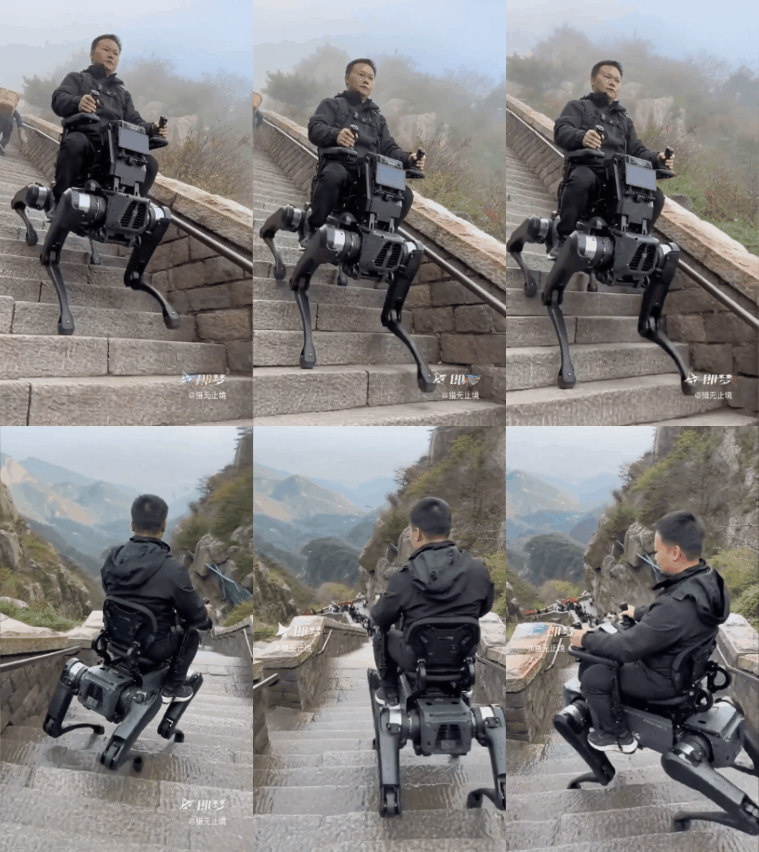
If you’re too lazy to hike, China’s got you covered. 😅
MORE ASIABITS
The Asiabits Podcast on YouTube.
The Asiabits Podcast on Spotify.
YOUR FEEDBACK
How do you like today's briefing? |