- asiabits
- Posts
- 🟠 US-China: decoupling? No.
🟠 US-China: decoupling? No.
Asiabits News

On AI glass, the US and China join forces

Just over a week ago, Donald Trump sat in the Great Hall of the People, the first US president on a state visit to Beijing in ten years.
The dominant topic: how far the US and China are really technologically decoupling from each other.
This week, the answer came from the glass industry of all places.
Corning, the American corporation behind the protective glass on millions of smartphones, has partnered with BOE, China's largest display manufacturer.
On May 20, both signed a framework agreement for three years. They've been working together for over two decades, now they're taking on four new fields: carrier glass for AI chips, foldable glass, glass for perovskite solar cells, and optical connections.
The stock market reacted immediately. BOE stock jumped ten percent in Shenzhen to the daily limit, the largest gain allowed in one day.
The irony: In the same week, Nvidia CEO Jensen Huang stated his share of the Chinese AI chip market had practically fallen to zero. While one US corporation writes off China, another goes deeper in.
The actual point is the division of labor. Corning masters the glass that withstands heat and connects chips better than today's carrier materials; BOE can manufacture it quickly and at scale. For the next AI hardware, each side needs exactly what the other has.
This layer cannot be cleanly cut through.
This is still just a letter of intent. BOE has been investing around one billion yuan in perovskite research since 2024, but nothing is in series production yet, and it's not generating revenue so far.
For everyone watching the press conferences right now, the lesson lies one level deeper.
On the political stage, it's about separation. In the material, a few layers below the chip, the interdependence simply continues.
OUR PARTNER
Attio - the AI CRM for modern businesses.
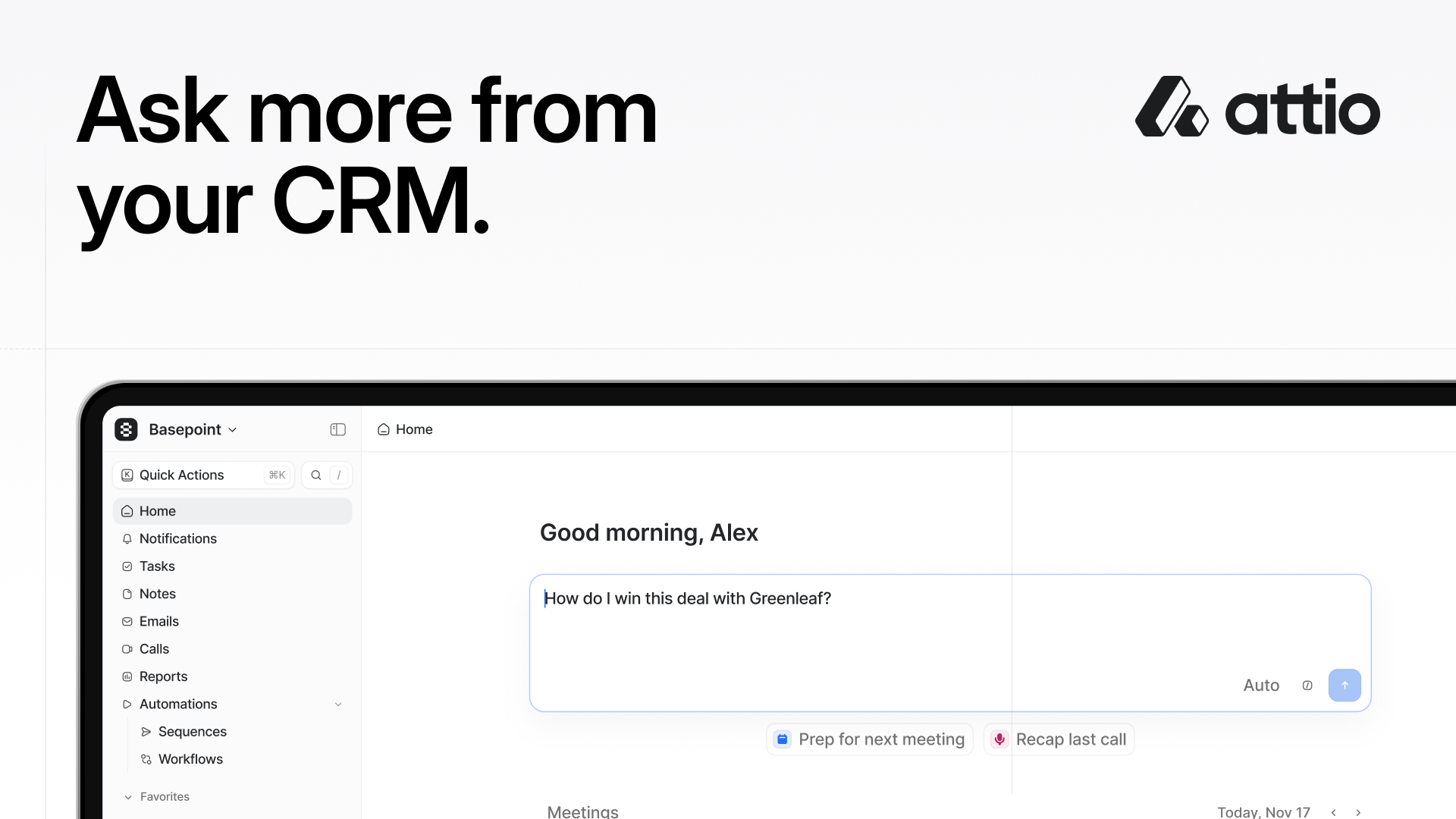
Attio is the AI CRM that keeps you ten steps ahead.
Ask Attio anything. Where should I focus? What deals are at risk? Search, update, and create across your customer data.
Ask more from CRM. Ask Attio.
FOUNDERS INSIGHTS

"If I help people in the West make money with real Chinese technology, maybe they'll finally believe it."
That's the conclusion Rafael Ratzel drew when longtime friends kept calling him "brainwashed" during the COVID period.
How does a 19-year-old with a one-way ticket to Hong Kong become a partner in a Tsinghua deep-tech fund worth over $100 million?
In August 2008, Rafael landed in Hong Kong with a suitcase, on the day of the biggest typhoon in the city's history.
What was supposed to be a St. Gallen degree became a full scholarship at PolyU, later an MBA at Tsinghua. For six years, he was "the guy in China who solves problems" for European industrial clients in Shenzhen. Then he joined TH Capital as a regular analyst.
Today, he's Managing Partner International there. But back home in Europe, skepticism grew with each visit.
Words didn't convince anyone. Money might.
His first dollar fund closed at $100 million at the end of 2024, with investors from Germany, Switzerland, the Middle East, Southeast Asia, and the US.
In the portfolio: Zhipu AI, from the angel round at 800 million RMB to the $50 billion IPO in Hong Kong.
Instead of continuing to argue, he invited his investors to China. His favorite example:
👉🏻 First investor meeting after fund closing, three days through Shenzhen, Shanghai, and Beijing, visiting twelve portfolio companies. Most had never been in the country before. At the end of the trip, they said: "This is incredible. We didn't imagine it like this."
Today, these very investors are promoting China themselves in Europe. "And people believe them. They're not considered brainwashed."
CHART OF THE WEEK

China is building more and more of its own robots, but can't break away from Japan.
In 2024, domestic manufacturers accounted for 57% of industrial robots sold in China for the first time.
Nevertheless, Japan delivers around three-quarters of imports: It controls about 75% of the world's precision gearboxes and the high-end robots for welding and chip production that China can't yet build in series.
In 2025, imports picked up again, driven by new e-car, battery, and semiconductor plants.
5 STORIES YOU MISSED LAST WEEK

🇨🇳 CATL to invest in DeepSeek: CATL, the world’s largest battery manufacturer, is in talks to participate in DeepSeek’s first external funding round. The target is around RMB 50 billion (USD 7.36 billion), at a post-money valuation well above RMB 350 billion. The round could close as early as June. JD.com and NetEase are also negotiating separate tranches. CATL wants to sell power-supply equipment into the expansion of AI data centers, following the same logic as its earlier move into vehicle manufacturing. With CATL on board, DeepSeek would not only become the best-funded AI lab in the country, but also the one most closely tied into China’s energy infrastructure.
🇨🇳 China’s largest chip foundry brings its Beijing plant in-house: China’s securities regulator has approved a USD 6 billion stock deal under which SMIC, the country’s largest contract chipmaker and China’s answer to TSMC, will acquire the remaining 49% of its Beijing foundry arm. SMIC already held the majority stake. Now, 547.2 million new A-shares will be issued to five external co-investors, valuing the stake at RMB 40.6 billion. It is the largest M&A transaction in the history of Shanghai’s STAR Market and brings the country’s most advanced wafer capacity fully under one listed roof. The Beijing plant is one of the few sites still running the nodes that Huawei, Cambricon, and DeepSeek have depended on since the Nvidia cutoff.
🇯🇵 Xi attacks Takaichi, Trump backs her: At the Beijing summit in May, Xi Jinping became noticeably loud and irritated when the topic of Japan’s military buildup came up. According to Xi, Prime Minister Sanae Takaichi and Taiwan’s Lai Ching-te are a threat to regional stability. Trump pushed back, pointed to the threat from North Korea, and told Xi that Takaichi was not the kind of leader who deserved such criticism. Tokyo has just loosened restrictions on defense exports and softened its anti-nuclear principles. Washington is now backing Takaichi by name, and the Xi-Takaichi axis has become the most exposed frontline in Asia.
🇰🇷 Samsung averts strike at the last minute: Samsung Electronics and its largest union have reached a preliminary wage agreement, just hours before a strike would have begun in its DRAM and NAND lines. The deal includes a special semiconductor bonus equal to 10.5% of operating profit, as well as a new profit-linked bonus formula for the chip division. Seoul was facing a real shock: Samsung memory chips go to Nvidia, Apple, and Chinese hyperscalers. A multi-week shutdown in the middle of the ongoing HBM shortage could have shifted orders to SK Hynix and Micron.
🇮🇷 Hormuz remains half-shut, Asia’s oil markets ride a rollercoaster: Last week, around 10 ships per day passed through the Strait of Hormuz, compared with 125 to 140 before Iran’s closure on February 28. On Thursday, a Chinese container ship was among the few vessels to make the passage. Around 20,000 seafarers are now stuck in the Gulf on hundreds of stranded ships. Oil prices swung sharply: on Wednesday, Brent fell 5.6% after Trump described US-Iran talks as being “in the final phase”; then on Friday, Brent rose again after Tehran signaled it would not give up its enriched uranium, closing at USD 103.54.
ALSO LAST WEEK
CXMT, China’s largest DRAM manufacturer, reported a net profit of RMB 24.7 billion (USD 3.6 billion) for the first quarter, an increase of 1,688 percent compared with the previous year, on revenue of RMB 50.8 billion (USD 7.5 billion).
In a “Humanoid Robot School” run by the company RealMan Intelligent Technology in Beijing, engineers are teaching humanoids real work tasks. Humanoids officially belong to China’s industrial strategy, on equal footing with EVs and AI.
China launched Shenzhou-23 into space on Sunday, with three astronauts on their way to the Tiangong space station. One of them, Zhu Yangzhu, is expected to stay in orbit for a full year, one of the longest single missions ever flown.
Bain Capital closed Asia Fund VI at USD 10.5 billion, a full USD 3.5 billion above the original target value of USD 7 billion. It is the largest pan-Asian PE round in years and a signal that global LPs are switching from pure China exposure to a developed-Asia barbell across Japan, Korea, India, and Australia.
Hyundai declares the Korean “EV chasm” to be over after EV demand at home jumped by 150.9 percent compared with the previous year in the first quarter.
YOUR FEEDBACK
How do you like today's briefing? |