- asiabits
- Posts
- 🟠 Midea: $8.7 billion for robots
🟠 Midea: $8.7 billion for robots
+ Nio turns first profit

☕️ Good morning friends,
We ourselves have been to the Midea Robots Factory and are still amazed by the developments in China: Phone manufacturers build cars, kettle manufacturers build robots. Crazy world!
Also in today's issue:
South Korea ramps up nuclear power plants
Deutsche Bank bets on Hong Kong
Vietnam's Dat Bike raises $4M for electric motorcycles
P.S. Yes, we're human and yesterday we included a 404 link in this spot.

China's yuan as safe haven: The won, yen and baht are sliding under the Iran war, but the renminbi holds steady at 6.89 per dollar, its strongest fixing since 2023. The PBOC is actually intervening less than usual, letting the exchange rate move more naturally.
The yuan remains stable regardless (just -0.1% in March). Demand for yuan is strong enough on its own, partly because China's exports are booming and mainland investors are buying Hong Kong stocks via Stock Connect at record levels.
TOP BIT
Midea: $8.7 billion for the leap from rice cooker to robot
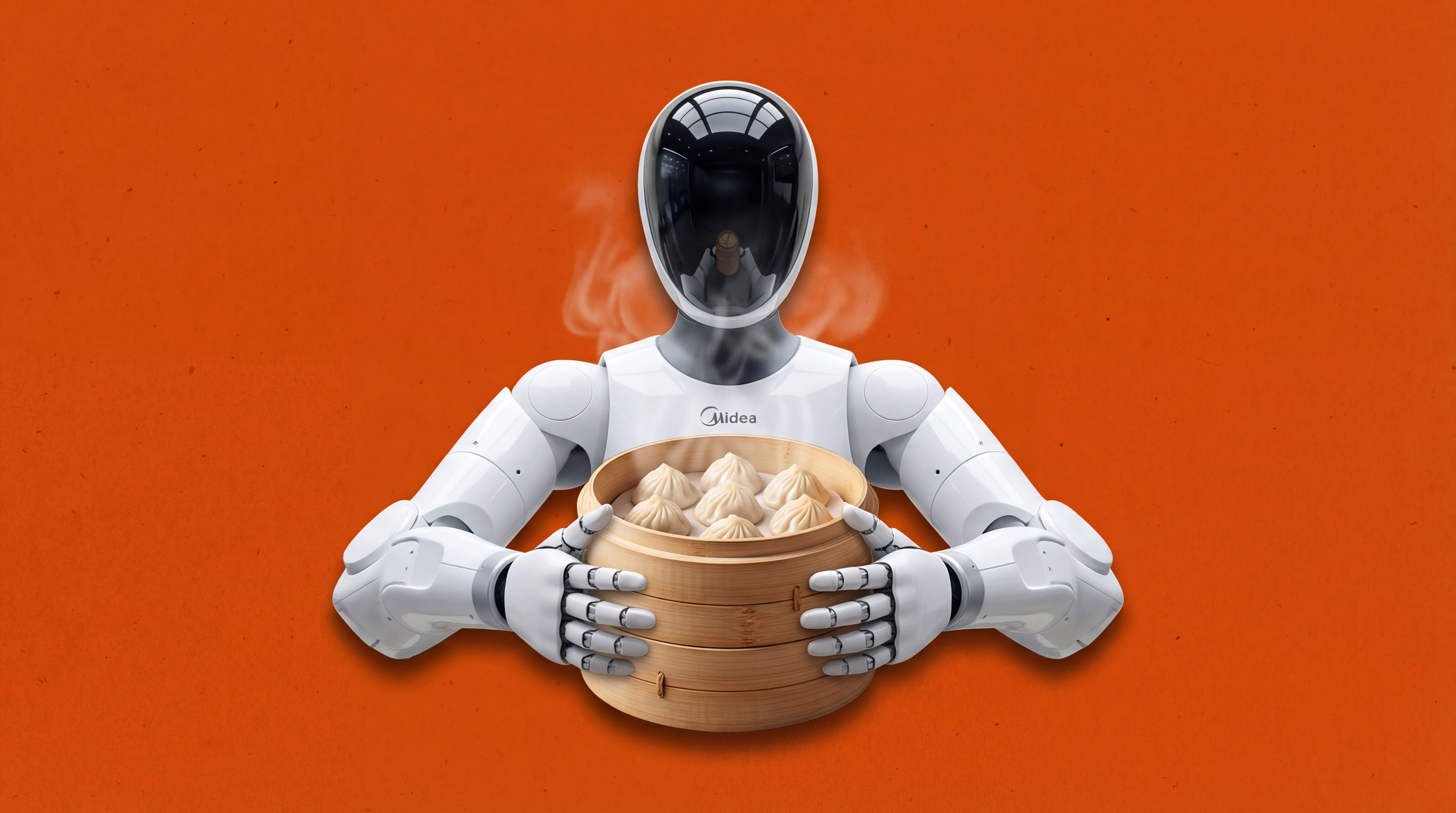
China's largest household appliance manufacturer Midea is investing 60 billion yuan ($8.7 billion) in AI and robotics over the next three years.
The sum equals the entire R&D spending of the past five years. In one fell swoop, Midea is thus doubling its research pace.
The Kuka factor
The company is not new to the robotics business. In 2017, Midea bought German robotics giant KUKA for 29.2 billion CNY (around €4 billion) and built China's largest industrial robot production base in Foshan, Guangdong.
A new robot rolls off the line there every 30 minutes, over 80,000 units so far.
In December came the next step: Miro U, a six-armed humanoid on wheels. In a washing machine factory in Wuxi, it increased efficiency in line conversions by 30%.
Entire industry follows suit
Midea is not alone. China's home appliance manufacturers are mutating into robotics companies:
Gree Electric: 2,000 self-developed industrial robots in Zhuhai factory
TCL: AI-controlled human-machine collaboration, one operator controls 384 ovens
Skyworth: AI equipment for all products from January 2026
Timing is no coincidence
Next week, Nvidia GTC 2026 starts, where new physical AI models are expected.
At the same time, Tesla is preparing the launch of Optimus Gen 3 for the second quarter.
China doesn't just want to keep up here, but dominate the market: The domestic humanoid market is expected to grow to 300 billion CNY ($43.8 billion) by 2035.
OUR PARTNER
Attio is the AI CRM for modern teams.

Connect your email and calendar and Attio instantly builds your CRM. Every contact, every company, every conversation — organized in one place. Then ask it anything. No more digging, no more data entry. Just answers.
MARKET BIT
Nio: From a $1 Billion Loss to a $40 Million Profit in One Year
The Chinese EV maker Nio posted a profit in the fourth quarter of 2025 for the first time since its founding. After ten years of losses and billions in burned capital, this marks a turning point.
Q4 net profit: 282.7 million yuan ($40.4 million) vs. a net loss of 7.1 billion yuan a year earlier.
The details
Revenue rose 76% to 34.7 billion yuan ($5 billion), while vehicle sales jumped 81%. In the fourth quarter, Nio delivered 124,807 cars, up 72% year over year.
The key driver was the ES8, Nio’s premium SUV with a starting price above 400,000 yuan (about $56,000) and a gross margin of around 20%. That model alone accounted for 46% of all deliveries in December.
At the same time, Nio cut costs aggressively:
F&D expenses: -44% to 2 billion yuan ($286 million)
Sales and administrative expenses: -28% to 3.5 billion yuan ($500 million)
Overall margin: from 11.7% to 17.5%
For 2026, Nio is targeting more than 450,000 deliveries, up from 326,000 for full-year 2025. In the first quarter, the company expects 80,000 to 83,000 vehicles, up around 90% year over year, but a noticeable decline compared with Q4.
The stock reacted accordingly: +15% in New York to $5.70, bringing market capitalization to around $14.4 billion.
Margin vs. volume
For years, Nio was seen as a textbook example of how brutal the price war in China’s EV market has become. The fact that a premium carmaker is now the first startup to turn profitable shows that margin beats volume.
For comparison: BYD achieved a gross margin of 17.6% in 2025 with 4.6 million cars sold. Nio reached 17.5% with 326,000 units.
The question is whether Nio can sustain that profit. Its 2025 full-year operating loss still stood at 11.5 billion yuan ($1.6 billion), and Q1 2026 is expected to be weaker.
STARTUP LAB
🇨🇳 China’s Simplexity Robotics raises $289M in six months: Tencent and Alibaba have invested in the embodied AI startup, which is building robots with “world understanding” capabilities. Initial units are already being produced in small batches in Beijing, Shanghai, and Suzhou.
🇸🇬 Singapore’s KAST secures an $80M Series A for stablecoin payments: QED Investors and Left Lane Capital are leading the round for former Circle executive Raagulan Pathy. The company already has more than 1 million users and about $5 billion in annualized transaction volume, with a goal of reaching $100 million ARR this year.
🇻🇳 Vietnam’s Dat Bike raises $4M for electric motorcycles: Thien Viet Securities is coming in after last year’s $22M Series B. The new funding will go toward production capacity and R&D as Vietnam looks to electrify its fleet of more than 45 million motorcycles.

HIGHLIGHTS
🇨🇳 China warns of "Terminator" future from AI in the military: China warned the US that unchecked use of AI in the military could create a dystopian future. The Trump administration is pushing for unconditional use of AI startups at the Pentagon and has cleared Musk's Grok system for classified settings. Anthropic was simultaneously blacklisted after the company spoke out against military applications.
🇰🇷 SK hynix unveils world's first AI smartphone chip: The Korean chipmaker has developed a 16-gigabit LPDDR6 DRAM based on its sixth-generation 10-nanometer process. The chip is designed for on-device AI in smartphones and uses 20% less power than its predecessor. For AI applications running directly on the device rather than in the cloud, this combination of speed and energy efficiency is the key bottleneck.
🇰🇷 South Korea fast-tracks nuclear restarts: The government is accelerating the restart of reactors currently undergoing maintenance. Two units are set to come online this month, with four more by mid-May. South Korea sourced about 14% of its LNG from Qatar in 2025, whose largest production facility has been shut down following an Iranian drone strike. If high oil prices persist, the impact on the power market will be "inevitable," the energy ministry said.
🇭🇰 Deutsche Bank bets on Hong Kong as wealth hub: The bank aims to capture wealthy investors from mainland China, Hong Kong, Taiwan, and the Philippines who are increasingly diversifying away from US assets. Unease over heavy US exposure is pushing capital toward Europe and Asia. Deutsche Bank is expanding its wealth management in the region and opening new teams in Hong Kong and Singapore.
MORE ASIABITS
Free guide: AI Automation for Beginners
Humanoid Robotics Report: The $6 Billion Bet
Interactive tool: China Dependency Index™
YOUR FEEDBACK
How do you like today's briefing? |