- asiabits
- Posts
- 🟠 LG now builds robots from washing machines
🟠 LG now builds robots from washing machines
A revolution?

☕️ Good morning friends,
Since last summer we've delivered the most important stories from Asia to you every morning for free.
That will stay the same: You'll continue to get one free issue per week with the 5 most important Asia stories.
The daily issues will become part of our new premium offering - for $25/month or $15/month with annual subscription.
Anyone who signs up now gets an additional 10% founders discount on top. Not bad for the price of one lunch per month. 😉
Thanks for being part of this!
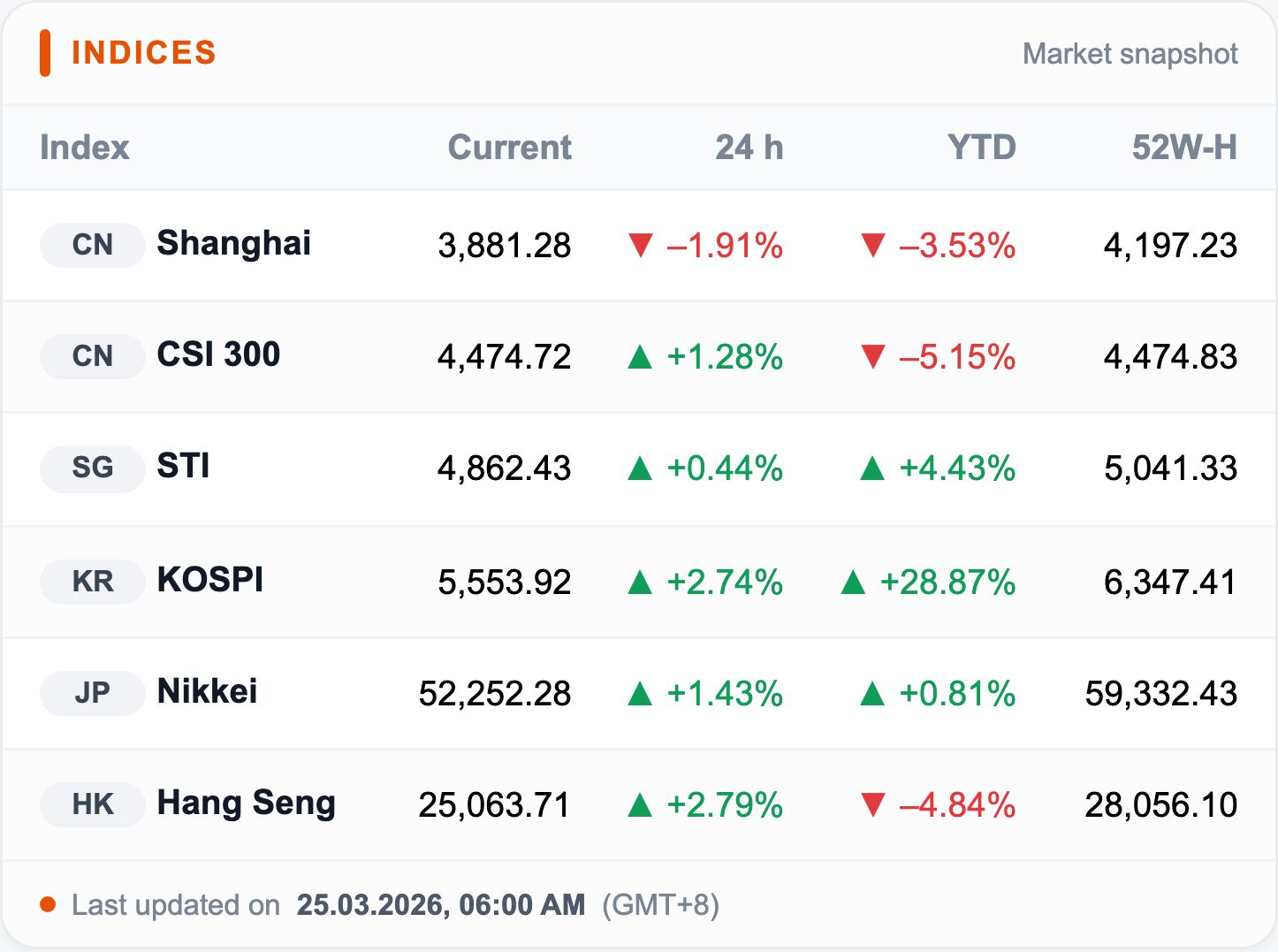
Asia back in rally mode: South Korea's benchmark index surged +4.39%, fueled by a Wall Street rally (Dow +1.38% to 46,208) and de-escalation signals from the Middle East. Hang Seng (+1.6%), Nikkei (+1.1%) and CSI 300 (+0.5%) followed suit, while Brent crude bounced back +3.5% to $103.70.
TOP BIT
LG offensive: from refrigerator motor to robot muscle

LG Electronics is making 2026 a pivotal year for its transformation.
At the general meeting in Seoul, CEO Lyu announced the radical expansion of the B2B robotics business.
The key: LG doesn't just want to build finished robots, but become the world's most important supplier for their "muscles." For this, the group uses its decades of experience from household appliance production.
"We will designate this year as the beginning of full-scale implementation of the robot business."
Strategy: "Axium" – hardware dominance
The centerpiece of the new strategy is actuators (drive elements). These account for over 40% of a robot's production costs.
Economies of scale: LG already produces 45 million motors annually for washing machines and refrigerators. This infrastructure is now being used for the new "Axium" actuator line.
Goal: LG wants to establish itself as a key supplier for global robot manufacturers, while its own brand CLOiD goes into commercial testing in 2027.
The 4 pillars of the "Physical AI" vision 2026
LG is leaving the pure consumer market and focusing on high-margin B2B sectors:
Focus area | Objective | Technological leverage |
|---|---|---|
Robot components | World market leader for actuators | Integration of motor, gearbox, and control technology. |
Data center cooling | Cooling for AI server farms | Liquid cooling for massive energy efficiency. |
Smart factories | Global B2B platform | AI-controlled manufacturing solutions (order backlog in the millions). |
AI home | "Home Orchestration" | Ecosystem that understands life patterns and autonomously optimizes the environment. |
Growth & efficiency: the AI transformation
CEO Lyu is planning a company-wide "AI transformation" to increase productivity by over 30% in the next three years.
Design automation: AI is to shorten development cycles and reduce costs.
Investor bonus: As a sign of confidence, LG increased the dividend by 35% to 1,350 won per share.
All details & data: Korea Times, The Korea Herald
OUR PARTNER
Attio is the AI CRM for modern teams.

Connect your email and calendar and Attio instantly builds your CRM. Every contact, every company, every conversation — organized in one place. Then ask it anything. No more digging, no more data entry. Just answers.
CROSS BORDER DEALS
Looking to acquire in Asia or find buyers for your company or sell-side mandate?

Asiabridge Partners helps M&A advisors, investors and corporates source qualified targets and buyers across borders between Asia and Europe.
Why us? Asiabridge Partners builds on years of experience at one of Europe's largest deal aggregators - now with our own team on the ground in China and Hamburg.
We know both sides of the table: the European M&A landscape as well as Chinese decision-makers.
Two recent cases:
Buy-Side: A European specialty chemicals group needed acquisition targets in East Asia. We screened 60+ candidates, shortlisted 15, and facilitated 3 NDAs.
Sell-Side: A Chinese industrial manufacturer (hydraulic components, ~EUR 20M revenue) needed European buyers. We delivered 7 qualified responses and 4 NDAs.
We combine AI-powered screening with on-the-ground networks in Shanghai, Shenzhen and Hamburg.
MARKET BIT
Asia PE fundraising hits $58bn, a 12-year low but exits are bouncing back

The Asia-Pacific private equity market is moving at two speeds.
Fundraising dropped to $58 billion in 2025, a 12-year low and down 37% year-on-year. At the same time, exit values climbed 24% to $150 billion.
The details
Asia's share of global PE fundraising: just 5%, down from 12% in 2021. New fund count dropped 44%. LPs have become pickier, backing managers with proven track records over newcomers.
Bright spot Japan: $15 billion raised (+12%), the only major market with growth in both deal value and count.
Deal activity was mixed overall: value down 8%, but count up 6%. Average buyout size shrank to $438 million (from $630 million the year prior), a five-year low. Multiples, though, climbed to 13.4x EV/EBITDA (from 11.9x).
Exits tell the real story
IPO and open-market exits jumped over 70%, trade exits over 60%. Large exits above $1 billion roughly quadrupled. Net distributions to LPs turned positive for the first time since 2021.
Greater China reclaimed top spot as the largest exit market, with exit volume up 76% year-on-year. South Korea's exits rose 38% despite political turmoil.
Sector shift: Tech fell to 25% of deal value, a 10-year low. Capital is flowing into advanced manufacturing (22%), energy (15%) and healthcare (14%) instead.
Dry powder: $240 billion sitting uninvested, down from a $315 billion peak in 2023.
What 2026 Looks Like
2020 to 2022 was the peak: low rates, high valuations, plenty of FOMO. Many GPs overpaid. Now, three to five years later, exits are due, and the math isn't working out for over a third of those deals.
Funds that bring their 2020-2022 investments to a clean exit now will get the next fundraise.
And the pipeline points to recovery: KKR (Asia V, $15 billion), EQT BPEA ($12.5 billion) and Blackstone (Asia III, $10 billion) are in market with mega-funds. Combined, the largest funds are targeting $61 billion.
Sources: SCMP, BusinessTimes, Bain
CHART OF THE WEEK
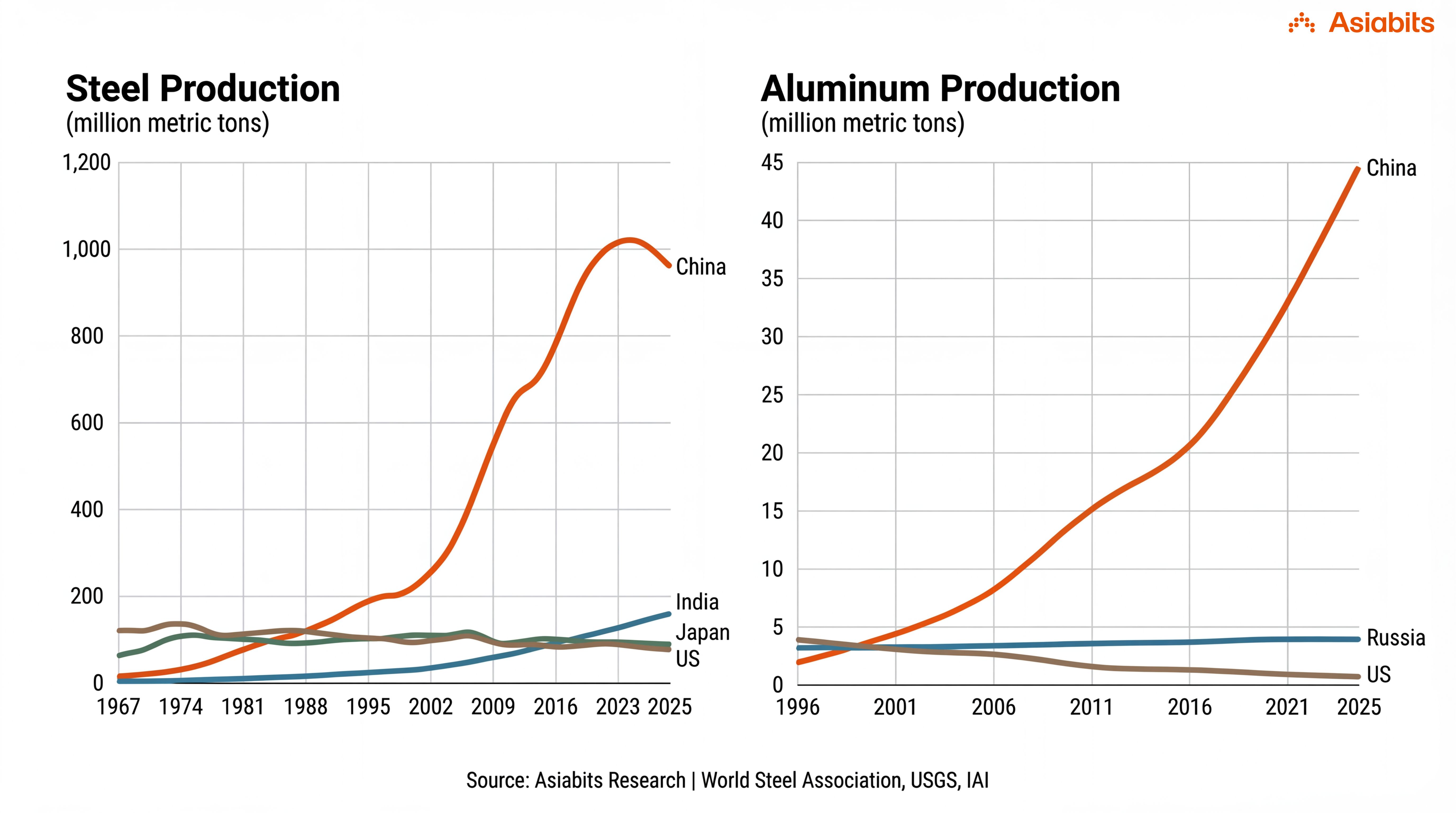
In 2025, China produced 960.8 million tons of steel, a decline for the first time in 15 years (-4.4%).
The reason: the real estate crisis has caused domestic demand to collapse.
In aluminum, however, China continues to grow: 45 million tons (2025), which is 60% of world production.
With this, China is reaching the self-imposed capacity limit that Beijing introduced for energy conservation. US aluminum production has fallen from 3.6 Mt (1996) to 0.6 Mt.
HIGHLIGHTS
🇹🇼 Grab Buys Foodpanda Taiwan for $600 Million: The Southeast Asian superapp is expanding beyond ASEAN for the first time. Grab will take over Delivery Hero's Taiwan operations, gaining a presence in 21 cities. Foodpanda Taiwan generated roughly $1.8 billion in gross merchandise value in 2025 and is already profitable. The deal is expected to close in the second half of 2026.
🇰🇷 Naver Goes All-In on AI Agents: South Korea's largest internet company plans to deploy AI agents across all services by year-end, backed by record R&D spending of over 2 trillion won ($1.33 billion). An AI Tab in its search engine goes live in the first half, while a shopping agent will expand to all categories by December. Agents for finance, health and local services will follow.
🇬🇧 British Energy Giant Bets on China: Octopus Energy, the UK's largest green electricity provider, has launched a joint venture called Bitong Energy with China's PCG Power. The goal: trade 140 TWh of renewable power annually in China by 2030. The partnership was unveiled during Prime Minister Starmer's visit to Beijing. CEO Greg Jackson calls China's clean tech the best in the world.
🇨🇳 China's Bubble Tea Chains Eye New Frontiers: Chagee is preparing to open its first store in South Korea, following Heytea, Mixue and Luckin Coffee. Over 60 Chinese F&B brands already operate more than 6,100 outlets across Southeast Asia. With the region getting crowded, Japan, Korea, the US and Europe are becoming the new targets. The global market for new-style tea drinks is projected to grow at 7.2% annually through 2028.
MORE ASIABITS
Free guide: AI Automation for Beginners
Humanoid Robotics Report: The $6 Billion Bet
Interactive tool: China Dependency Index™
YOUR FEEDBACK
How do you like today's briefing? |