- asiabits
- Posts
- 🟠 Beijing allows hands-free driving
🟠 Beijing allows hands-free driving
Reading time: 4 min 48 sec
In partnership with


Today’s edition is written by:
Anna, Michael & Thomas
☕️ Good morning, friends,
there is a reason why we deliberately keep this newsletter short.
Too much distraction can quickly become… problematic in everyday work.
In China, an engineer has now been fired because he regularly spent over an hour in the office bathroom, once even four hours straight.
With that in mind: we’ll keep it short. 😉
SHARING IS CARING

👉 One friend, one click, your China Starter Kit!
Recommend asiabits to a friend or colleague and the ultimate China guide will land straight in your inbox. And thanks to you, we keep growing. 🧡
https://news-en.asiabits.com/subscribe?ref=PLACEHOLDER
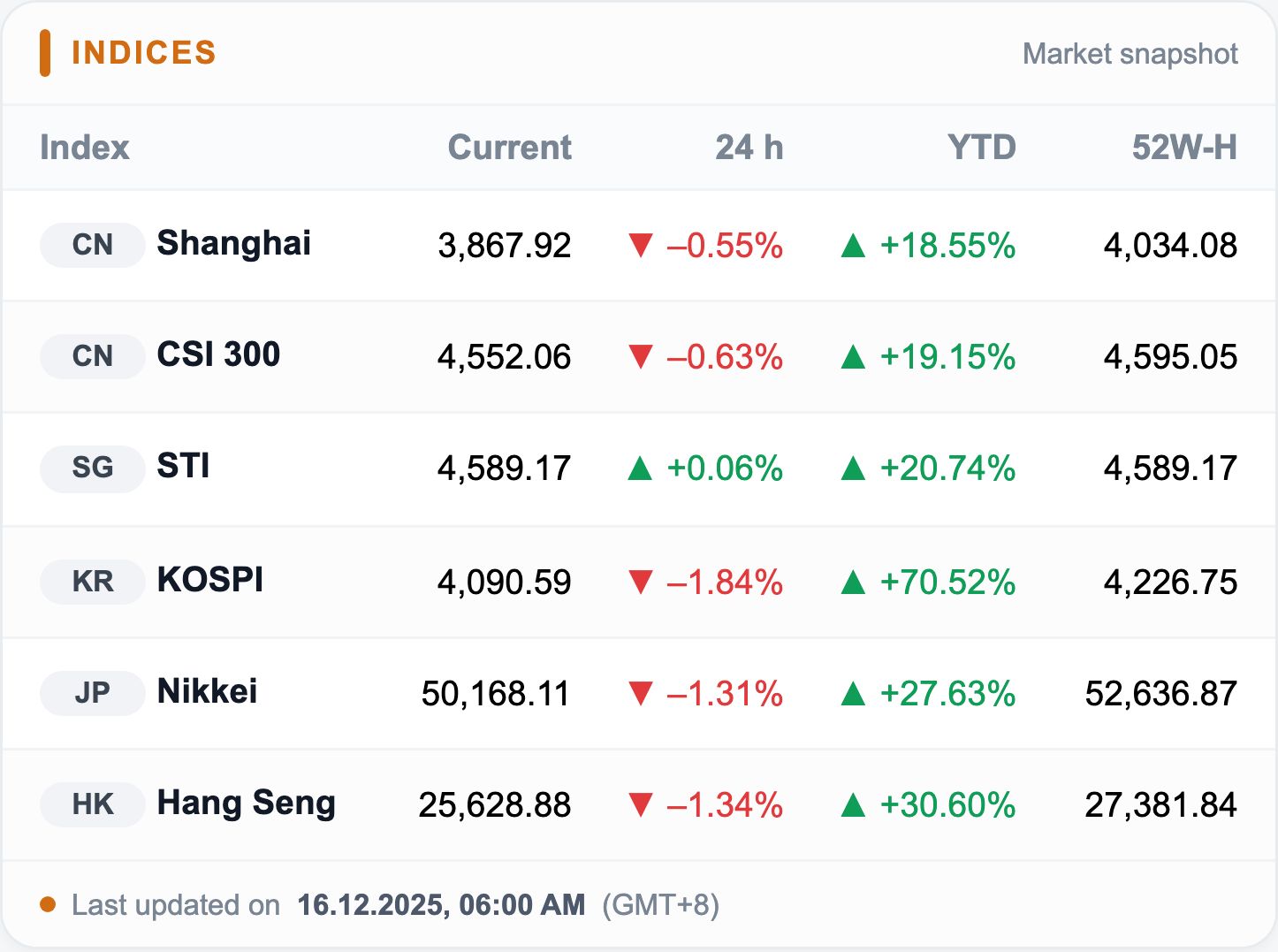
Highlights: A weak start to the week in Asia, with sentiment weighed down mainly by disappointing economic data from China.
November figures showed a clear loss of momentum: retail sales grew at the slowest pace since late 2022, while industrial output and investment also missed expectations. Investors responded with profit-taking, particularly in tech and consumer stocks.
TOP BIT
🚦 Free Pass for the First "Hands-Off" Generation

China is taking a huge regulatory leap:
The Ministry of Industry and Information Technology (MIIT) has approved the first two passenger car models for L3 autonomous driving.
This means that in clearly limited situations, the car is allowed to take over, but the driver remains on call – so it's "hands off," but not "brain off."
Details
🇨🇳 Go for two brands: The approval goes to state-owned manufacturers Changan Automobile (with the Deepal SL03) and BAIC (with the Arcfox Alpha S).
🚦 Pilot in traffic jams: Changan gets the green light for an L3 electric sedan that takes over in defined congestion scenarios on expressways, sticking to its lane up to 50 km/h.
🛣️ Arcfox plays faster: BAIC’s model is cleared for highway sections, where it can drive up to 80 km/h in L3 mode, also only on selected routes.
⚡ Component boom: Core components like LiDAR sensors, high-performance chips, and steer-by-wire/brake-by-wire systems are now seeing a boost, as they are essential for reliable L3 implementation.
⚖️ Next industry step: The state is signalling that L3 should move out of the perpetual demo phase and into a regulated, liable reality, with close supervision instead of a "free-for-all" approach.
The liability breakthrough
The L3 approval marks a major regulatory breakthrough, as China is officially shifting liability from humans to machines.
The manufacturers (Changan, BAIC) must now prove that their L3 systems are absolutely reliable under the approved conditions, as they will be held accountable in the event of a system failure.
📊 All Details & Data: SCMP, TechNode, AsiaFinancial
OUR PARTNER
Shoppers are adding to cart for the holidays

Over the next year, Roku predicts that 100% of the streaming audience will see ads. For growth marketers in 2026, CTV will remain an important “safe space” as AI creates widespread disruption in the search and social channels. Plus, easier access to self-serve CTV ad buying tools and targeting options will lead to a surge in locally-targeted streaming campaigns.
Read our guide to find out why growth marketers should make sure CTV is part of their 2026 media mix.
NUMBER OF THE DAY

This is how low the acceptance rate for sperm donations in China has become.
🧬 Quality in decline: At a major sperm bank in Hunan, the success rate was still 45.9% in 2006. Today, only around 20% of donations meet the quality criteria, a level that matches the national average. Reasons include environmental pollution, heat, stress, and lifestyle factors.
🧴 Lotion instead of therapy: Chinese researchers are testing a topical lotion designed to improve sperm quality and motility. In animal and laboratory studies, it showed effects even in cases of damage caused by plastics, heavy metals, or aging.
Watch: The decline in fertility has long been a structural problem. Whether high-tech medicine, prevention, or lifestyle change, China is searching for pragmatic solutions while the demographic clock keeps ticking.
MARKET BIT
🧹 Clean sweep deal: iRobot sold to its Shenzhen supplier

👀 Restart under supervision: After years of losses and a failed search for buyers, Roomba maker iRobot’s public-market chapter comes to an end. The company will be delisted from Nasdaq and restructured under US bankruptcy protection.
🇨🇳 Manufacturer takes control: iRobot will be acquired by a subsidiary of its main contract manufacturer, Shenzhen-based Picea Robotics. Outstanding receivables are converted into equity, leaving existing shareholders wiped out.
📉 Price war crushes margins: Revenue fell 25% year-on-year in the last quarter, with a $21.5 million loss. Cheaper Chinese rivals intensified competition, while US tariffs added roughly $23 million in extra costs in 2025.
🛑 Amazon deal as the turning point: Amazon’s planned $1.7 billion acquisition collapsed after EU antitrust opposition. Since then, iRobot continued to slide despite a $94 million breakup fee and multiple restructuring efforts.
🔧 Operations continue: Customers should see no disruption. Products and the app remain active, while iRobot will operate as a private company through February 2026, reducing debt and prioritizing survival over growth.
Background
Western consumer hardware brands are losing ground to Asian manufacturers that control costs, production, and supply chains. Innovation alone is no longer enough — whoever owns the factory ultimately ends up owning the brand.
iRobot was valued at over $3 billion in 2021. Today, it’s worth around $137 million. In 2024, the company posted a net loss of $145.5 million, and the stock is down roughly 45% year to date.
👉🏻 Full Story: The Guardian, CNBC, AP News, DealStreet Asia
HEAD OF THE DAY
🇺🇸 Edwin Chen

🧠 The "Anti-Mainstream" Billionaire
Edwin Chen grew up in his parents' Chinese restaurant, teaching himself math between the kitchen and the register. Now, with a valuation of $24 billion USD, he is one of America’s youngest billionaires.
The Gap: Chen realized that the AI industry was crippled by a lack of high-quality, human-like data.
The Solution: His company, Surge AI, acts as a "Translator of Human Knowledge." They train AI to understand complex nuances like sarcasm, emotions, and cultural context.
Anti-Hype Strategy:
No fundraising. No major launches. No show.
Yet, over $1.2 billion in annual revenue.
Clients: OpenAI, Meta, Google.
HIGHLIGHTS
🤖 Unitree launches the first App Store for humanoid robots: The Chinese robotics startup is rolling out a public beta for a platform where robot functions can be installed like smartphone apps. Users can download movement routines from the cloud, share their own models, or use datasets for training. At launch, offerings include dance moves and even a “Bruce Lee” mode that uses motion capture to transfer classic martial arts to Unitree’s humanoids, showing where the robot ecosystem is headed.
🤖 Panasonic is stuck with its AI ambitions: The group wanted to enter the AI business in a big way with the family app “Umi.” The app was meant to organize everyday family life, suggest meal and fitness plans, and learn personal habits. However, the launch has been delayed multiple times and is now completely in doubt. Panasonic is also shutting down the household service “Yohana” after failing to find a viable business model. The core problem: Panasonic wants to grow in AI but has yet to find a product that truly takes off.
🧬 Detecting cancer via blood test: Singapore-based startup Lucence is planning to expand in the US. Tailwinds come from the government health insurance program Medicare, which covers a large share of the costs for Lucence’s blood test used in cancer diagnosis. The test can provide indications of 15 types of cancer, making it significantly more affordable for patients. In addition, a partnership with Mayo Clinic Laboratories opens access to thousands of clinics.
COUNTRY READS
🇹🇭 Thailand’s finance minister warns of an overly strong baht that is weighing on exports and slowing economic growth. More on this.
🇯🇵 Japan is sending its last pandas back to China, ending 50 years of panda diplomacy. More on this.
🇺🇸 Trump’s latest mediation attempt fizzles out. Fighting between Thailand and Cambodia continues. More on this.
BITS TO DO
✅ Pretend to be that healthy person and freeze super-ripe persimmons for the best sorbet.
✅ Test your ego on South Korea’s brutal English exam.
✅ Feel like a movie star and visit the real-life Avatar mountains.
✅ Listen to Japanese Jazz and cut dementia risk by nearly 40%.
✅ Learn Korean over the holidays and say more than just “Annyeong” on your next trip.
FORTUNE COOKIE

Service alert: Don’t forget to protect your skin, even in winter! 😉
MORE ASIABITS
All the latest AI trends from Asia — every Wednesday, exclusively with us.
Champagne & Chopsticks — your Sunday guide to Asia’s best insider spots.
CAREER BITS
🌏 Xiaomi: E-Commerce Sales Intern, Singapore
🌏 IBM: Business Analyst-2025 graduate, Beijing
🌏 Alibaba: Influencer-Marketing, Seoul
🌏 Ericsson: Future Star-Account Manager, Beijing
🌏 Gap Inc.: Junior Operations Specialist, Tokyo
🌏 Databricks: Business Development Representative, Seoul
🌏 OpenAI: Community Lead, Singapore
🌏 Uber: Account Executive, Taipei
🌏 Sea: Partner Strategy & Operations Associate, Singapore
🌏 Thales: Business Development Representative (Japan), Chiyoda